
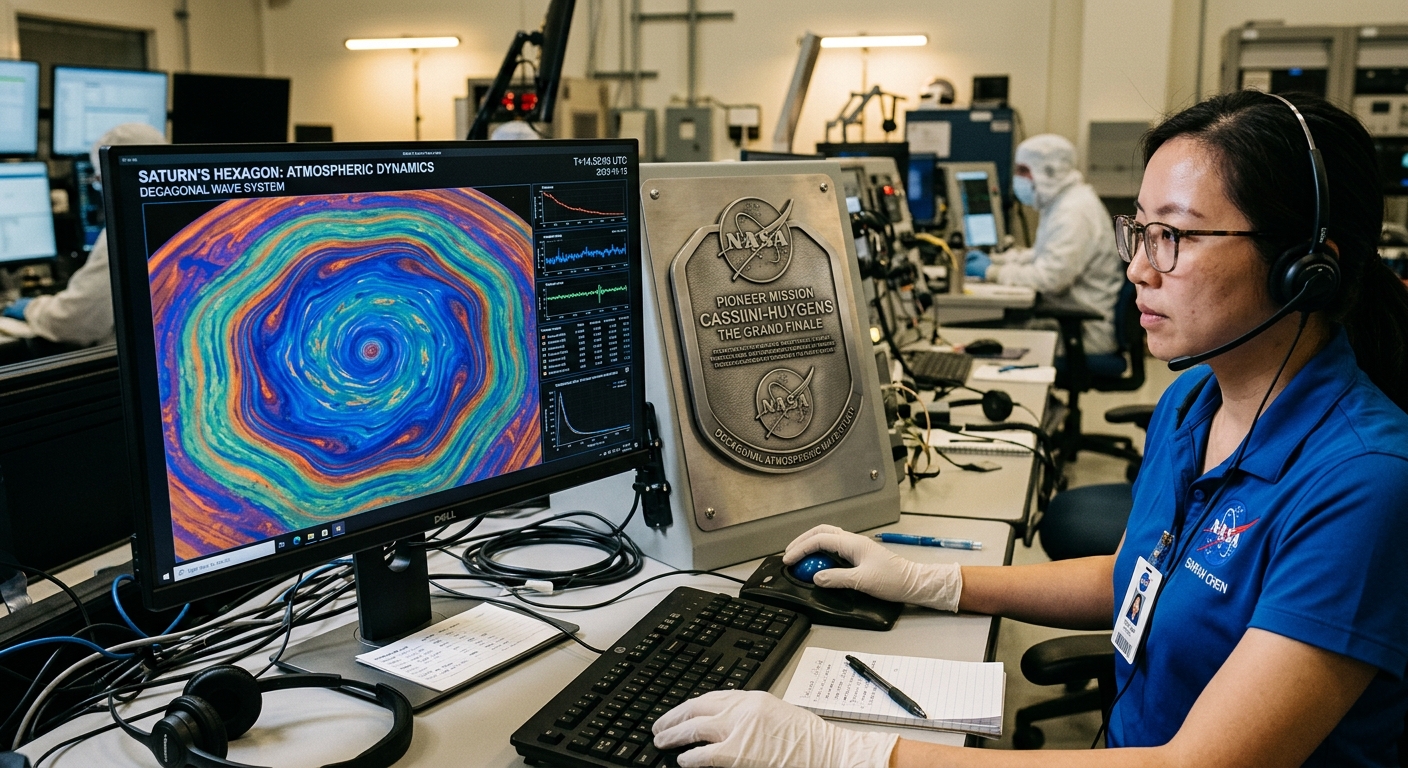
NASA’s Hubble Space Telescope has identified a massive, evolving 10-sided wave circling Saturn’s south pole. This marks the first documented observation of a regularly shaped, multi-sided jet pattern within the planet’s southern hemisphere, sharing morphological traits with the northern polar hexagon while exhibiting distinct developmental mechanics.
The discovery stems from multi-year archival analysis via the Outer Planet Atmospheres Legacy (OPAL) program, tracking high-resolution imaging sequences captured since 2023. Longitudinal wind profile reconstructions reveal that the structure evolved from nascent, low-amplitude perturbations into a sharply defined decagonal wave front.
Atmospheric Dynamics and Structural Comparisons
While Saturn’s northern polar hexagon has persisted as a stable, stationary Rossby wave structure for over four decades, the newly discovered southern feature displays active strengthening phases. This temporal evolution indicates that seasonal insolation shifts and hemispheric asymmetry heavily dictate zonal jet stability and wave resonance patterns.
| Feature Parameter | Northern Hexagon (North Pole) | Southern Decagon (South Pole) |
|---|---|---|
| Symmetry Order | Hexagonal ($n = 6$) | Decagonal ($n = 10$) |
| Observation History | Continuous (>40 years) | Emergent (Identified in 2023–2026 data) |
| Evolutionary State | Quasi-stable stationary wave | Actively strengthening and evolving |
| Primary Instrument | Voyager, Cassini, Hubble (OPAL) | Hubble Space Telescope (OPAL Program) |
Planetary dynamicists attribute these polygonal waveforms to barotropic instabilities within steep zonal wind gradients. The transition from a hexadeca- or decagonal geometry points to distinct velocity shear profiles and vertical thermal wind thermalization unique to the southern polar vortex.
- Hubble’s OPAL program isolated the first confirmed 10-sided wave pattern encircling Saturn’s southern polar region.
- Unlike the permanent northern hexagon, the southern decagon is actively strengthening, offering real-time empirical data on giant planet atmospheric evolution.
- Seasonal solar heating shifts appear to drive hemispheric asymmetries in Saturn’s polar wave dynamics and zonal jet formation.