
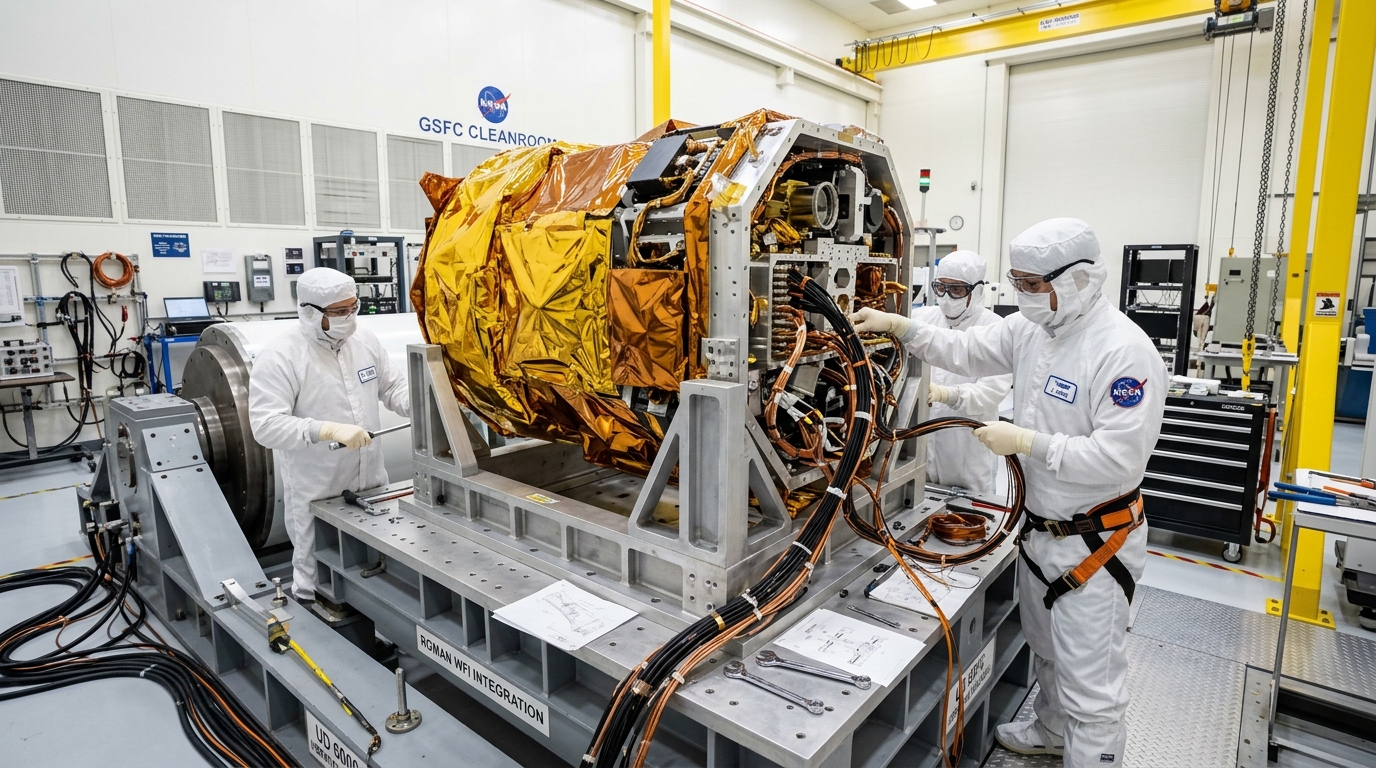
The Engineering Challenge: Astrophysical observatories historically face a critical trade-off between angular resolution and field of view (FoV). High-resolution instruments often possess a narrow FoV, necessitating extensive mosaicking for large-area surveys, which is time-intensive and susceptible to observational gaps. Conversely, wide-field instruments frequently compromise on angular resolution or spectral depth, limiting their utility for detailed characterization of distant or faint phenomena. A system capable of simultaneously achieving sharp infrared vision across an exceptionally wide sky segment represents a significant architectural hurdle, crucial for advancing dark energy, dark matter, and exoplanet research across vast cosmic scales.
Technical Mechanism & Architectural Solution
The Nancy Grace Roman Space Telescope is engineered to resolve this fundamental observational constraint. Its design integrates advanced optics to deliver sharp infrared imaging concurrently with an unusually wide field of view. This combination allows for efficient examination of expansive celestial regions while simultaneously penetrating far back into cosmic history. The observatory’s primary scientific objectives include detailed investigations into dark matter, dark energy, and the characteristics of exoplanets.
The mission hardware, a $4-billion project, leveraged spy-satellite-sourced technology, indicating a highly optimized sensor and optical array designed for both fidelity and breadth. The telescope launched aboard a SpaceX Falcon Heavy rocket from Launch Complex 39A, demonstrating the necessity for a high-capacity launch vehicle to place the instrument into its distant operational orbit.
| Feature | Prior Infrared Observatories (General Approach) | Nancy Grace Roman Space Telescope |
|---|---|---|
| Field of View (FoV) | Typically narrow, optimized for extreme depth or specific targets. | Unusually wide, enabling broad sky surveys at high resolution. |
| Imaging Capability | Sharp infrared, often requiring extensive mosaicking for wide areas. | Sharp infrared vision combined with an expansive FoV, minimizing survey time. |
| Primary Utility | Focused deep-sky observations or targeted object characterization. | Wide-area cosmic mapping, deep historical look, comprehensive surveys. |
| Key Mission Scope | Specific stellar/galactic evolution, atmospheric studies, etc. | Dark matter, dark energy, exoplanet demographics, and serendipitous discoveries. |
Implementation Considerations
Following its launch, the observatory has commenced a three-month transit, covering approximately one million miles, en route to its definitive orbital position. Telemetry downlink from Roman to NASA’s Goddard Space Flight Center was established seven minutes post-liftoff, confirming initial system health and deployment success. The Falcon Heavy rocket executed its launch sequence as planned, achieving observatory separation 31 minutes after liftoff. The precision of the launch vehicle’s performance suggests that Roman may require fewer trajectory correction maneuvers than initially projected, potentially conserving onboard fuel reserves and extending the operational lifespan of the mission. This optimal deployment minimizes the energy expenditure for orbital insertion and station-keeping.
- The Nancy Grace Roman Space Telescope addresses the critical technical gap of simultaneously providing sharp infrared imaging across an expansive field of view, enabling unprecedented wide-area astrophysical surveys.
- Its $4-billion, spy-satellite-derived architecture facilitates detailed studies of dark matter, dark energy, and exoplanets across vast cosmic distances.
- A flawless SpaceX Falcon Heavy launch has positioned Roman for reduced fuel expenditure during its million-mile transit, potentially extending its operational mission beyond initial projections.
- Telemetry confirmation moments after launch and successful observatory separation confirm the robust initial deployment phase, critical for its upcoming three-month journey to final orbit.