
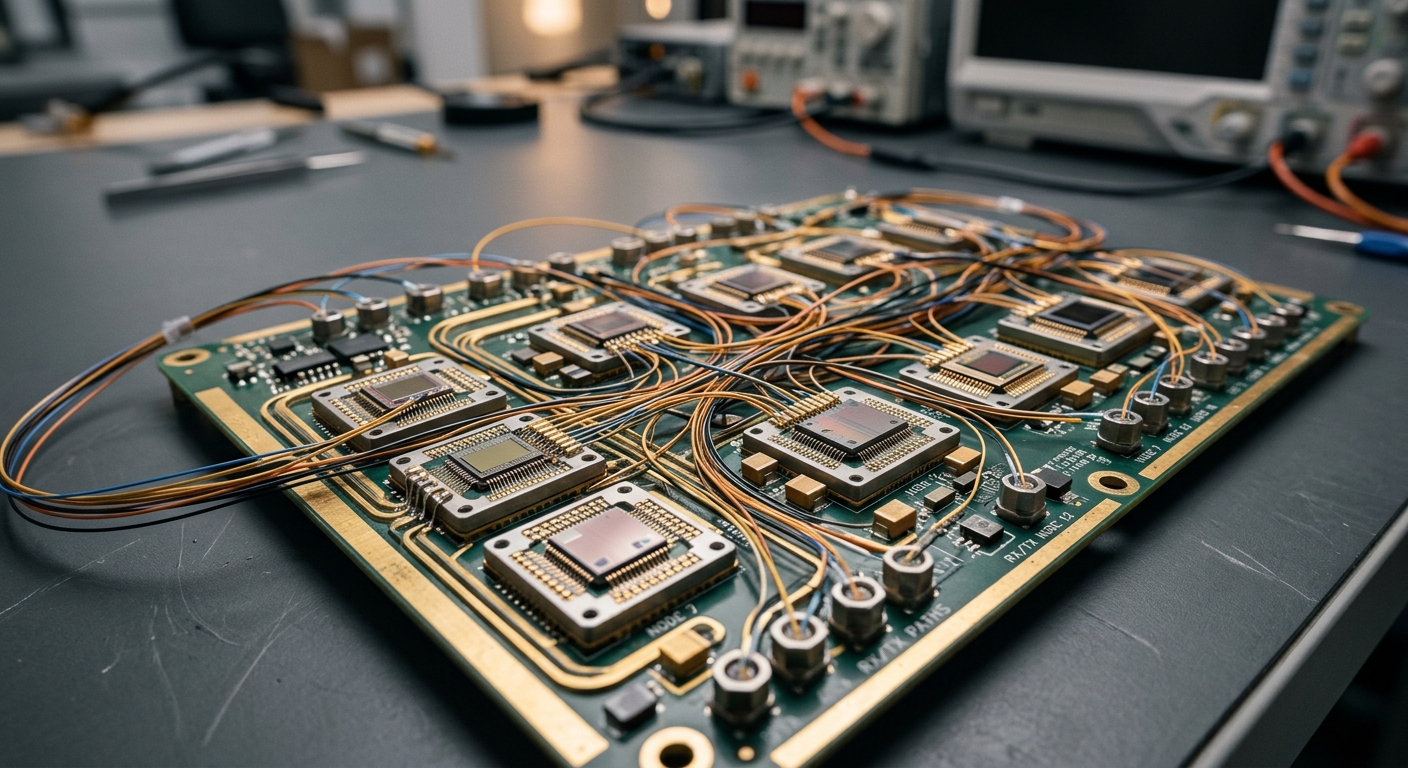
Enterprise AI deployment has abruptly shifted from monolithic single-agent inference to distributed multi-agent fleets, creating a compounded routing complexity that severely overwhelms traditional API gateways. As autonomous agents recursively query internal APIs and secondary models, infrastructure teams face critical failures in network observability, multi-hop request tracing, and access governance.
- O(n²) Connection Scaling: Adding a new autonomous agent to an enterprise network does not scale linearly; it exponentially increases internal API request vectors, demanding significantly higher control-plane bandwidth and advanced rate-limiting logic.
- Zero-Trust Authorization Gaps: Multi-hop agent execution bypasses standard Identity and Access Management (IAM) controls, allowing unchecked lateral movement across data silos without explicit cryptographic human-in-the-loop (HITL) approvals.
- Compute and Memory Overhead: Unmanaged agent-to-agent recursive calling causes redundant token generation and prolonged KV cache retention, severely degrading GPU memory bandwidth utilization and increasing thermal TDP loads across the cluster.
Technical & Architectural Context
Modern enterprise infrastructure was engineered for deterministic microservices, not non-deterministic machine decision-makers. When a primary agent executes a chain-of-thought (CoT) process requiring data from an external application, it initiates a series of REST or gRPC calls that often trigger downstream secondary agents. This protocol cascade results in a distributed mesh of autonomous actors where connection topologies rapidly approach complete bipartite graphs, exponentially increasing internal network traffic.
From an infrastructure perspective, this lateral API traffic spikes network I/O and creates severe distributed tracing opacity. Current observability platforms rely on static trace IDs passed through predictable service meshes, which fail when a large language model (LLM) unpredictably spins up parallel sub-agents to resolve a query. Security operations centers (SOC) are subsequently blinded, unable to audit which specific autonomous node initiated a downstream database write action three hops removed from the ingress gateway.
The hardware implications of runaway agent complexity are equally severe at the compute layer. Each unmonitored agent-to-agent handoff requires a fresh context window allocation, forcing the inference cluster to constantly shuffle KV cache data across PCIe 5.0 lanes or NVLink bridges. When agent fleets operate without strict API routing governance, the resulting redundant FP16 and FP8 matrix multiplications waste massive amounts of VRAM bandwidth, directly impacting the cluster’s overall throughput and thermal efficiency.
Traditional API gateways lack the deep packet inspection capabilities required to parse semantic LLM payloads. Standard rate limiting based on HTTP requests per second is insufficient for agent fleets, as a single API call can trigger thousands of backend compute tokens. Infrastructure requires specialized gateways that can enforce quotas based on actual compute utilization and precision workloads rather than simple network request counts.
Strategic Outlook & Next Milestones
To mitigate these cascading system failures, enterprise architecture must evolve toward dedicated AI API gateways capable of agent-aware traffic shaping and dynamic authorization. Expect the rapid adoption of specialized control planes that inject cryptographic provenance into every LLM-generated API payload, ensuring robust tracing via frameworks like OpenTelemetry. This will allow security teams to explicitly map the entire chain of custody for any automated multi-hop decision down to the millisecond.
Over the next 12 to 18 months, hardware-accelerated ingress controllers will become standard in enterprise hyperscaler deployments. These components will offload agent routing, token quota tracking, and policy enforcement directly to Data Processing Units (DPUs) and SmartNICs. By handling this administrative overhead at the network interface layer, infrastructure engineers can preserve primary GPU clusters for raw TF32 and FP8 compute workloads.