
Technology has dramatically transformed the modern classroom, offering new opportunities and challenges for educators and students alike. This article explores the multifaceted impact of technology on education, examining the recent trend of limiting phone use in schools, the rise of artificial intelligence (AI) in the classroom, and the potential benefits and drawbacks of these developments.
The Evolving Role of Technology in Education
Technology has become an integral part of the learning process, with computers, tablets, and interactive whiteboards becoming commonplace in classrooms. These tools provide students with immediate access to vast amounts of information, facilitate collaboration, and enable personalized learning experiences. Digital tools like academic journals, project management platforms, and study apps allow students to explore various subjects, conduct research, and access materials beyond traditional textbooks. Technology also fosters creativity and innovation by enabling students to create multimedia presentations, design projects, and develop prototypes.
Furthermore, technology empowers students to take ownership of their learning, expanding opportunities for self-directed and personalized learning experiences. Online courses and educational apps offer flexibility, allowing students to learn at their1 ownpace and tailor their educational journey to suit their individual needs.
The integration of technology has also changed the roles of teachers and learners. Teachers can now leverage technology to create more engaging and interactive lessons, while students can take a more active role in their learning. Technology also enables one-on-one interaction between teachers and students, allowing for personalized support and feedback. Students can ask questions and seek help on challenging topics, while teachers can provide individualized guidance and monitor progress more effectively.
However, it’s crucial to balance the use of technology with traditional learning methods. While technology offers numerous benefits, over-reliance on digital tools can hinder the development of essential skills, such as critical thinking, problem-solving, and communication. Encouraging activities like visiting libraries, reading printed books, and engaging in hands-on experiments can help students develop a well-rounded skill set and avoid becoming overly dependent on technology.
Limiting Phones in the Classroom: A Growing Trend
While technology offers numerous benefits, the ubiquitous presence of smartphones in schools has raised concerns about distraction and potential negative impacts on learning. A student survey found that, on a typical day, the average student receives hundreds of notifications on their phone, about a quarter of which arrive during the school day. This constant influx of notifications can significantly disrupt students’ concentration and hinder their ability to focus on classroom activities.
In response to these concerns, many schools and districts have implemented policies to limit or prohibit phone use during instructional time. Many states have passed laws or enacted policies that ban or restrict students’ use of cellphones in schools statewide. Many of the largest school districts forbid cellphone use during the school day. California, Texas, and Florida, the three most populous states, have either introduced or enacted legislation to limit smartphones in schools. A National Education Association (NEA) poll found that most teachers support prohibiting student cellphone use during instructional hours, with many favoring extending restrictions to the entire school day.

Several schools have successfully implemented phone restriction policies. One school district requires students to lock devices in “cell phone pouches” at the start of every class. Similarly, another district requires high school students must stow phones in backpacks and use them only between classes and during lunch, while elementary and middle school students can’t use them at all, unless an administrator makes an exception.
One notable example is the “Off and Away” policy implemented in a school district. This policy requires students to keep their phones off and away during instruction time, with designated “cellphone hotels” in every classroom to store devices. The policy has been praised for reducing distractions and promoting student engagement.
The Pros and Cons of Limiting Phones
The debate over cellphone use in schools highlights the complex interplay between technology and education.
Pros of Limiting Phones
Proponents of phone restrictions argue that they:
- Reduce distractions and improve academic performance. Research has shown that students without access to cellphones perform better on exams. This suggests that removing the temptation of phones can help students concentrate better and achieve higher academic outcomes.
- Promote social interaction and face-to-face communication. By limiting phone use, schools encourage students to engage with each other directly, fostering social skills and building stronger relationships.
- Address concerns about cyberbullying, lower self-esteem, and privacy issues. Excessive phone use, particularly on social media, can contribute to cyberbullying, social comparison, and anxiety. Limiting phone use can help mitigate these risks and create a safer and more supportive school environment.
Cons of Limiting Phones
However, opponents of phone bans argue that they:
- Can hinder the learning experience and student-teacher relationships. Some argue that phones can be valuable learning tools when used appropriately, providing access to information, facilitating research, and enabling creative projects.
- Raise safety concerns for students and parents. Some students and parents express concerns about not being able to communicate in emergencies or reach out to each other if needed.
- May not address the root cause of the problem. Simply banning phones may not be enough to address the underlying issues of student engagement and responsible technology use. Instead, schools should focus on teaching digital literacy and self-regulation skills.
- Can contribute to health problems associated with excessive phone use. These include eye strain, neck problems, disrupted sleep, and anxiety. Limiting phone use during school hours can help reduce these risks and promote healthier habits.
- May negatively impact students’ sense of connection and well-being. An observational study showed that spending more than a few hours per week using electronic media correlated negatively with self-reported happiness, life satisfaction, and self-esteem2 among adolescents.
Ultimately, the decision of whether or not to limit phone use in schools requires careful consideration of the specific context and the needs of the students and teachers.
The Rise of AI in the Classroom
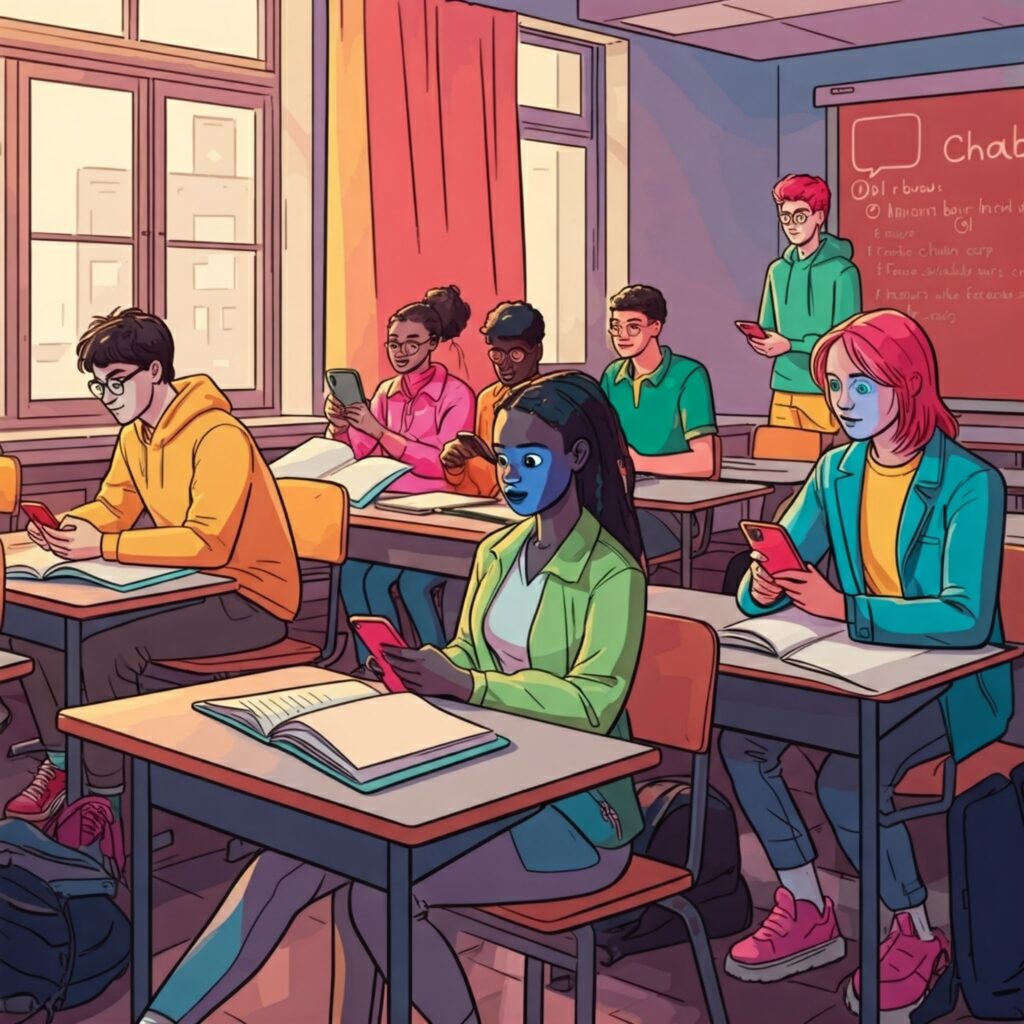
Artificial intelligence is rapidly changing the educational landscape, offering new possibilities for personalized learning, automated tasks, and enhanced student engagement. AI-powered platforms can analyze student responses in real-time to adapt lessons dynamically, enabling every student to master concepts at their own speed. AI can also automate grading, scheduling, and report generation, reducing the workload on educators.
In addition to enhancing learning outcomes, AI can also streamline managing school infrastructure. For example, AI can perform time-consuming and error-prone resource planning tasks like calculating the right amount of food, learning materials, or stationery and ensuring it’s timely purchased and delivered.
AI is also being used to create more engaging learning experiences. Programs use AI to create interactive quizzes and simulations that respond to student input, keeping learners motivated and involved.
It’s important to note that technology, including AI, will not replace good teachers. Instead, AI tools can enhance teachers’ ability to support students’ affective intelligence, creativity, and communication. By automating routine tasks and providing personalized insights, AI can free up teachers to focus on building relationships, fostering critical thinking, and providing individualized support.
The Pros and Cons of AI in Education
The use of AI in education presents both exciting opportunities and potential challenges.
Pros of AI in Education
Proponents of AI in education highlight its potential to:
- Personalize learning. AI can tailor educational content to each student’s unique learning style and pace, providing individualized learning paths and adaptive feedback.
- Improve accessibility. AI-powered tools can create more inclusive learning environments for students with disabilities. For example, AI can generate personalized learning materials, such as worksheets, quizzes, and reading assignments, aligned with students’ learning goals, strengths, and interests. AI can also enable text-to-speech and speech-to-text capabilities, ensuring that all students can access educational content.
- Enhance efficiency. AI can automate administrative tasks, freeing up valuable time for educators to focus on teaching and mentoring.
- Provide personalized feedback. AI technologies analyze a student’s performance and offer detailed insights into their strengths and areas for improvement. This feedback helps students understand where they stand and what they need to work on, enhancing their comprehension and learning process.
- Enhance data analysis for improved results. AI models can collect and analyze detailed data on student learning outcomes and behavior patterns, providing teachers with clear and actionable reports.
Cons of AI in Education
However, critics of AI in education express concerns about:
- Reduced human interaction. While AI is a great ally for personalized feedback and support, it can’t replace the human connection that teachers offer. The lack of human touch can lead to a dehumanized learning experience and may affect students’ social and emotional development.
- Ethical considerations. AI systems are built on large volumes of data, and biased data can lead to discriminatory results. It’s crucial to ensure that AI algorithms are developed and used ethically, promoting fairness and avoiding bias.
- Over-reliance on technology. While AI can be a valuable tool, it’s important to avoid over-dependence on technology and ensure that students develop critical thinking and problem-solving skills independently.
- Job displacement. As AI automates tasks and improves efficiency, it may lead to job displacement in various sectors, including education. It’s important to prepare students for a future where AI plays a significant role in the workforce and equip them with the skills needed to adapt to changing job markets.
Case Studies: Schools Implementing Technology
Several schools have successfully implemented technology in the classroom, demonstrating the potential benefits of these innovations. One district has seen significant improvements in standardized test scores after implementing a laptop initiative. Another district has successfully integrated technology into its alternative learning program for at-risk students.
A case study at a university explored the impact of technology access on problem-solving abilities. Students were divided into two groups: one with access to electronic gadgets and one without. The study found that the group without technology access demonstrated greater collaboration and resourcefulness in their problem-solving approaches.
In the realm of AI, some schools are using adaptive learning platforms to assess students’ language processing skills and provide tailored support. One school is using AI to assist with lesson planning and save time. At another school, a “cellphone hotel” program was implemented with the support of teachers and administration who saw phones as a hurdle to effective instruction.
Conclusion: Navigating the Technological Landscape

Technology is undeniably transforming the classroom, offering new tools and approaches to education. While the use of technology in schools presents both opportunities and challenges, it is crucial for educators, administrators, and policymakers to carefully consider the potential benefits and drawbacks of these developments.
The integration of technology in education requires a balanced approach. While technology can enhance learning experiences, it’s essential to avoid over-dependence on digital tools and ensure that students develop essential skills, such as critical thinking, problem-solving, and communication. A balanced approach combines innovation with traditional learning methods, fostering a well-rounded education that prepares students for the future.
Teacher training and professional development are crucial for effectively utilizing technology in the classroom. Educators need support and guidance to integrate technology seamlessly into their teaching practices, personalize learning experiences, and address the ethical considerations surrounding AI in education.
The role of educators is evolving in a technology-rich learning environment. While technology can automate certain tasks, teachers remain essential for fostering relationships, providing emotional support, and guiding students’ social and emotional development. AI can be a valuable tool for teachers, but it cannot replace the human connection and the nuanced understanding that educators bring to the classroom.
The ethical considerations surrounding AI in education require careful attention. It’s crucial to ensure that AI algorithms are developed and used responsibly, promoting fairness, avoiding bias, and protecting student privacy. As AI becomes more prevalent in education, it’s essential to teach students about ethical considerations related to AI and empower them to use technology responsibly.
By embracing innovation and addressing concerns thoughtfully, we can harness the power of technology to create more engaging, effective, and equitable learning environments for all students.
Recent Tech Stories
- China’s Chang’e 7 Lunar Mission Delayed from Planned Launch Window
- TOFA: Reprogramming Cellular Metabolism for Adipose Reduction and Glucose Homeostasis
- ToxicPanda Android Malware Evolves: VPN Hijacking and Expanded Attack Surface
- Probing the Quantum Void: How Squeezed Light Outperforms Classical Photons in Revealing Vacuum Non-Linearity
- Microsoft Patches Maximum-Severity Entra ID Flaw Exploited In-The-Wild