
The Illusion of Self-Sufficiency
During periods of international tension, the message from leadership often emphasizes America’s robust domestic production. President Donald Trump, for instance, confidently asserted that the U.S. was “in great shape for the future,” possessing ample fuel reserves to remain unaffected by crises like those triggered by attacks in the Middle East. He claimed that the nation, as the world’s biggest oil and gas producer, did not rely on the tankers navigating contested waterways. This perspective paints a picture of a fortress America, impervious to external energy shocks.
However, this narrative of complete self-sufficiency, while appealing, masks a more complex economic reality. The sheer volume of domestic production, while impressive, does not automatically translate into an insulated market. Oil is a globally traded commodity, and its price is determined by a confluence of supply, demand, and geopolitical factors on an international scale. The fungible nature of crude oil means that a barrel produced in Texas competes, or at least interacts, with a barrel from Saudi Arabia or Russia on the world stage.
Global Markets Dictate Local Prices
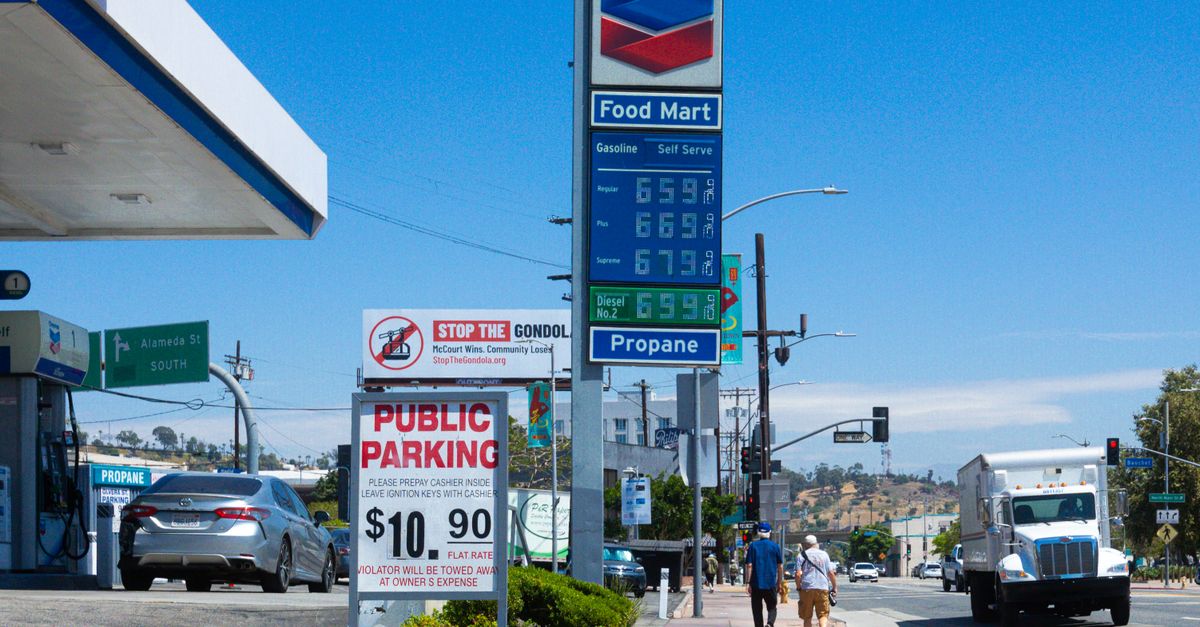
The current surge in gasoline prices, with many service stations reporting over $4 per gallon for the first time in four years, directly contradicts the notion that domestic production alone can stabilize prices. The primary source points to a significant financial burden on American households, which collectively paid an estimated $8.4 billion more for gasoline in just one month following recent geopolitical disruptions, compared to pre-crisis levels. This substantial increase underscores that global events, particularly those affecting critical shipping lanes, exert a powerful influence over what consumers pay at the pump.
The Strait of Hormuz, for example, is a narrow yet vital maritime choke point through which approximately 20% of the world’s oil and liquefied natural gas (LNG) passes. When this passageway faces threats of closure or disruption, as it did recently amidst tensions and disputes over potential tolls, the global supply chain reacts immediately. Even if the U.S. isn’t directly importing oil from tankers passing through the Strait, the disruption to global supply reduces overall availability and increases benchmark prices. These elevated international prices then inevitably ripple down to domestic markets, regardless of local production levels.
The Economic Ripple Effect of Geopolitical Instability
The ongoing tensions surrounding the Strait of Hormuz serve as a prime illustration of how geopolitical leverage directly impacts economic stability. Despite a temporary ceasefire intended to reopen the Strait, reports indicate that most tankers remained blocked as sides sparred over deal specifics. Iran’s clear intent to maintain control over the passageway, including the potential to levy multimillion-dollar tolls on tankers for post-war rebuilding, further exacerbates uncertainty and pricing pressures. Even the prospect of such fees, reportedly already being charged, contributes to higher transportation costs, which are ultimately passed on to consumers.
The oil industry’s reported lobbying efforts against Iran’s demands highlight the severity of these potential economic impacts. Such actions indicate that even major players within the energy sector recognize the profound influence global shipping lanes and geopolitical bargaining have on market stability and profitability. Ultimately, these costs and uncertainties are externalized, meaning they appear as higher prices at the gasoline pump for the average American driver.
Beyond Production: Towards True Energy Resilience
The current situation unequivocally demonstrates that record domestic oil and gas production, while a significant achievement for energy security, does not equate to absolute consumer price protection. True energy resilience extends beyond mere volume of extraction. It demands a multifaceted approach that acknowledges the interconnectedness of global markets, mitigates geopolitical risks, and invests in diverse energy portfolios that can genuinely buffer consumers from international price shocks.
For American households, the recent spikes are a costly lesson in the complexities of the global energy landscape. Moving forward, the focus must shift not only to maintaining robust domestic production but also to developing strategies that can better insulate the consumer from the inherent volatility of a globally traded commodity, ensuring that the benefits of energy abundance are truly felt at every gas pump.