The landscape of 3D printing has evolved dramatically since its inception over four decades ago. What once promised merely novelties and prototypes now delivers sophisticated solutions, from biodegradable kitchenware and artificial animal skin to entire structures built from sustainable materials. This transformative technology continues to push boundaries, and a recent breakthrough by two innovative graduates signals its most ambitious application yet: harvesting potable water directly from the atmosphere.
In a world grappling with increasing water scarcity and environmental challenges, the ability to create clean drinking water on demand, sustainably, is no longer a futuristic fantasy but an urgent necessity. This is precisely the vision driving “Water from Air,” a pioneering project that leverages advanced 3D printing to tackle one of humanity’s most critical needs. This innovation represents not just a technological leap but a beacon of hope for communities worldwide.
Behind this groundbreaking initiative are Louisa Graupe and Julika Schwarz, recent graduates from FH Münster University of Applied Sciences. Their collaborative effort culminated in “Water from Air,” a device that embodies ingenuity and a commitment to practical, sustainable solutions. Their work underscores a growing trend in engineering: utilizing advanced manufacturing techniques, like 3D printing, to address complex global challenges directly. The project, officially unveiled on October 13, 2025, quickly captured attention for its audacious yet achievable goal.
Graupe and Schwarz recognized the immense potential of 3D printing to create highly specialized, efficient structures that traditional manufacturing methods often struggle to replicate. Their focus on atmospheric water generation stems from a deep understanding of the global water crisis, where millions lack access to safe drinking water. Their approach combines cutting-edge materials science with practical engineering, offering a glimpse into a future where essential resources are generated locally and sustainably.
How “Water from Air” Works Its Magic
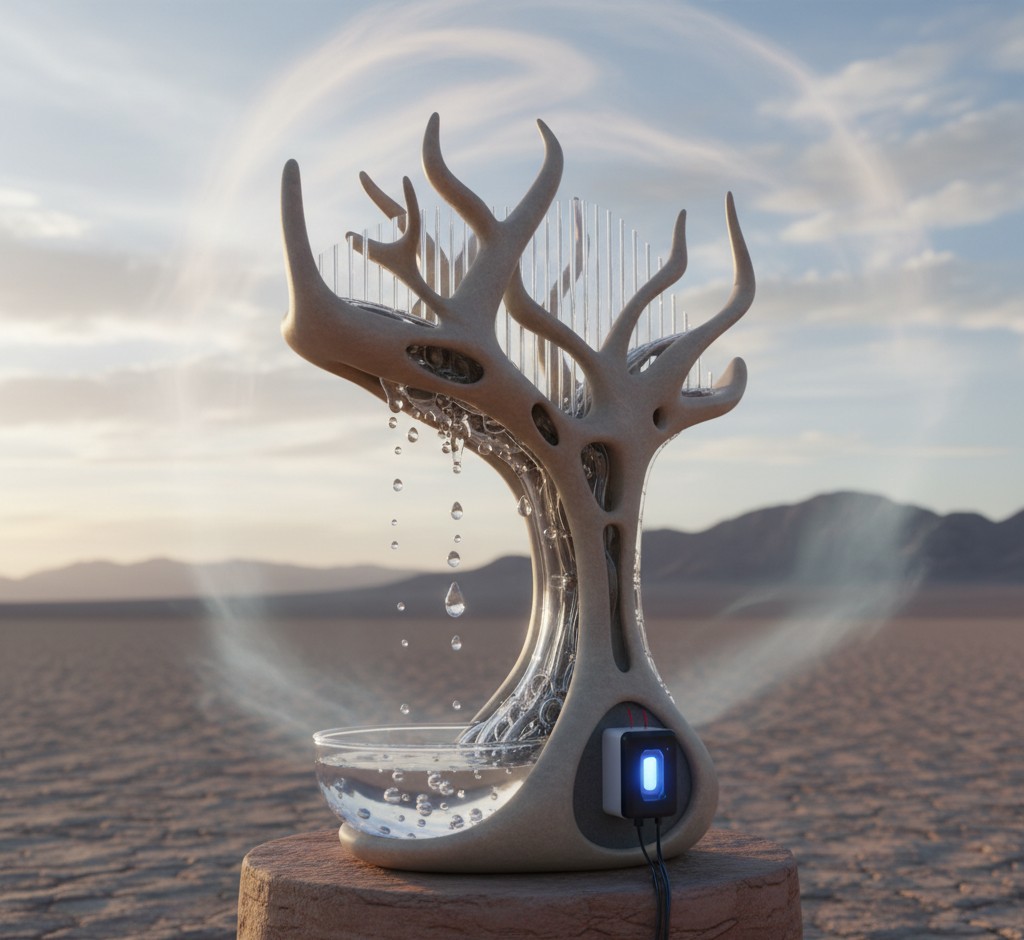
The “Water from Air” device is a testament to sophisticated design and functional integration. At its core, the prototype is engineered to draw moisture directly from the ambient air, a ubiquitous resource. Once captured, specific internal components are responsible for trapping these water molecules, separating them from other atmospheric gases and particulates. This crucial initial step is followed by a condensation process, converting the collected water vapor into liquid, drinkable water.
A key innovation within the device lies in its use of “metal-organic frameworks” (MOFs). These highly porous, crystalline materials are celebrated for their exceptional ability to capture and store gases. In the context of “Water from Air,” MOFs play a critical role in purification. By actively interacting with and removing most air pollutants, these frameworks potentially eliminate the need for additional, cumbersome filtration stages. This integration of purification at the point of collection significantly streamlines the process and enhances the quality of the output.
The device’s design prioritizes user accessibility and practical application. Crafted primarily from 3D-printed materials, it demonstrates the versatility and cost-effectiveness of additive manufacturing. Its compact form factor is designed for localized deployment, making it ideal for individual use or small community settings. A built-in spigot at the bottom provides a direct and convenient means to dispense the collected water into a cup or storage container, ensuring immediate access to clean hydration. With an impressive claimed capacity of up to 1.6 gallons (approximately 6 liters) of clean drinking water per day, the “Water from Air” prototype offers a substantial daily yield for personal or small-scale needs.
Beyond the Prototype: Impact and Future Potential
While still a work in progress, the implications of “Water from Air” are profound. The ability to generate clean water autonomously, without reliance on complex infrastructure or extensive energy input, holds immense promise for regions suffering from water scarcity, disaster relief efforts, and off-grid living. Imagine remote villages, emergency camps, or even individual households gaining independence from unreliable water sources or expensive bottled water. This device offers a decentralized solution to a centralized problem.