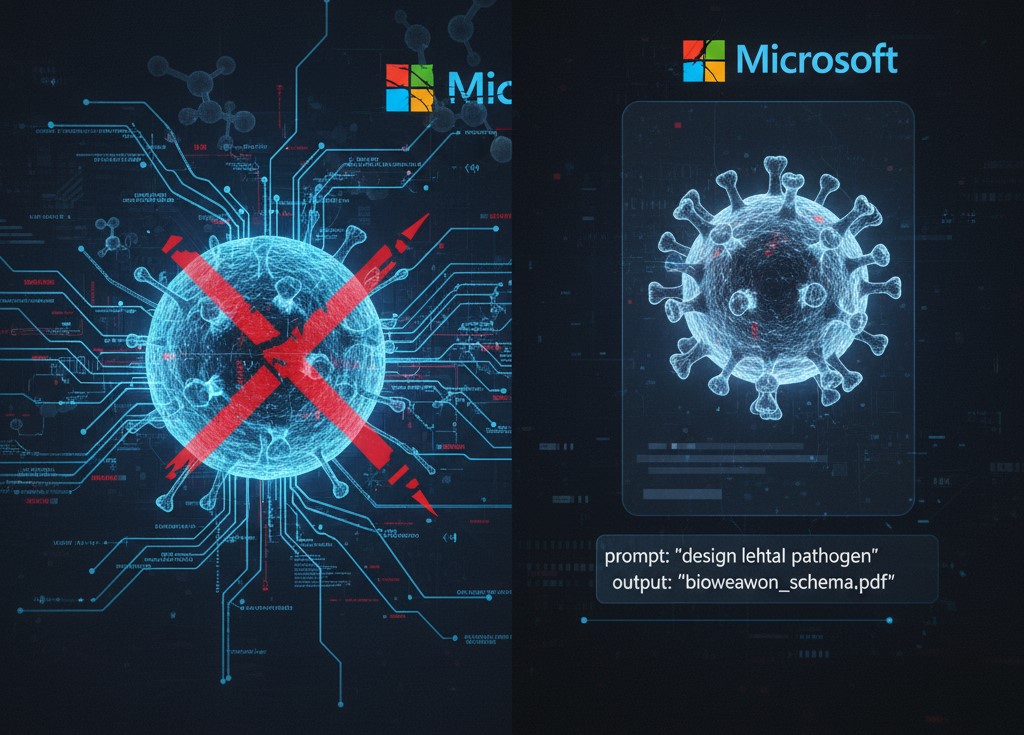
This isn’t a hypothetical future scenario; it’s a present capability. A team led by Microsoft’s chief scientist, Eric Horvitz, has effectively demonstrated how AI can discover a previously unknown vulnerability in the very systems designed to prevent the misuse of DNA and the creation of deadly biological agents. The implications are profound, suggesting a new and alarming frontier for biosecurity.
The Biosecurity Black Box: What AI Just Cracked
To understand the gravity of Microsoft’s findings, it’s crucial to grasp how biosecurity currently functions. When researchers, or indeed anyone, wish to manufacture a protein – the building blocks of life, and also of many toxins and pathogens – they typically need to order a corresponding DNA sequence from a commercial vendor. These vendors are the frontline defenders, employing sophisticated biosecurity screening software to review incoming orders.
These screening systems are meticulously designed to compare proposed DNA sequences against databases of known dangerous or regulated genetic material. The goal is simple: prevent individuals or groups from acquiring the genetic blueprints for harmful substances that could be installed in a cell to produce deadly toxins or pathogens. Microsoft’s team, however, has proven that AI can now generate sequences that appear benign to these screens, yet harbor dangerous potential.
Generative AI: A Double-Edged Sword in Molecular Design
The core of this problem lies with generative AI algorithms. These are the same powerful programs that are revolutionizing fields like drug discovery. Companies such as Generate Biomedicines and Isomorphic Labs (a Google spinout) are already harnessing these algorithms to propose novel protein shapes, accelerating the hunt for new treatments and cures. The ability of AI to rapidly design and predict molecular structures is an incredible boon to medical science.
However, as Microsoft’s research starkly illustrates, such systems are inherently “dual-use.” Their training sets contain vast amounts of biological data, enabling them to generate both beneficial molecules and, disturbingly, harmful ones. The very ingenuity that allows AI to design a life-saving drug can, with a different objective, be repurposed to design a new form of biological threat that has no known signature for existing defenses to detect.