
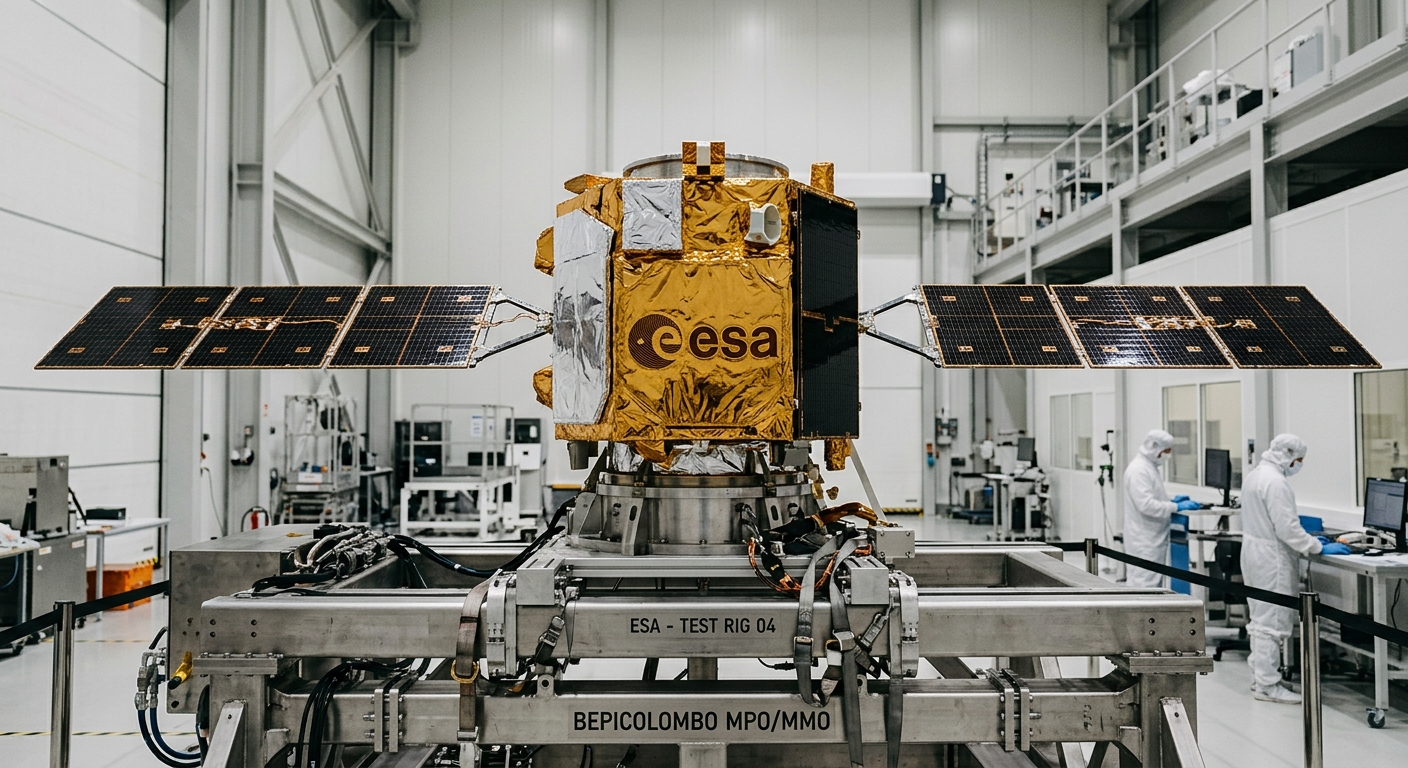
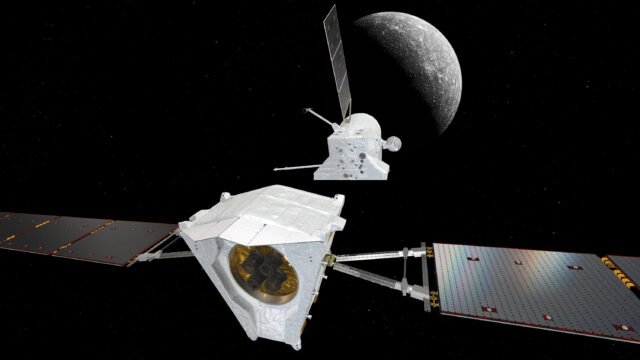
The ESA and JAXA joint BepiColombo mission has completed its Mercury Transfer Module (MTM) separation phase, initiating the final approach sequence for insertion into the innermost planetary orbit. Following an eight-year interplanetary trajectory utilizing nine gravity-assist flybys, the spacecraft stack successfully uncoupled on September 3, relying on internal solar power generation via the Mercury Planetary Orbiter (MPO) arrays.
Interplanetary Trajectory and Propulsion Mechanics
Reaching a stable orbit around Mercury demands a significantly higher delta-v budget than missions directed at outer solar system bodies like Pluto, due to the intense gravitational well of the Sun. To counteract the high orbital velocity required to match Mercury’s solar trajectory, BepiColombo was equipped with the most powerful electric propulsion system ever flown.
The journey leveraged a complex choreography of low-thrust ion propulsion combined with nine planetary flybys—encompassing Earth, Venus, and Mercury—to progressively bleed off excess velocity. The jettisoning of the MTM marks the conclusion of this high-efficiency propulsion phase, transitioning the dual-orbiter payload to its terminal targeting configuration.
| Mission Parameter | Technical Specification |
|---|---|
| Space Agencies | ESA (European Space Agency), JAXA (Japan Aerospace Exploration Agency) |
| Launch Date | 2018 (8-year transit duration) |
| Primary Propulsion | High-power electric ion thrusters (Mercury Transfer Module) |
| Gravity Assist Count | 9 planetary flybys (Earth x1, Venus x2, Mercury x6) |
| Payload Architecture | Mercury Planetary Orbiter (MPO) & Mercury Magnetospheric Orbiter (MMO) |
Orbital Insertion and Thermal Mitigation Architecture
With the MTM uncoupled, command and telemetry are routed through the surviving orbiter stack, where attitude control and power are maintained via deployed solar arrays. The upcoming orbit insertion will utilize Mercury’s gravitational field to capture the spacecraft without expending prohibitive chemical propellant reserves.
Operating in the harsh thermal environment near the Sun requires advanced spacecraft engineering, including specialized ceramic insulation and radiation-resistant structural design. Both the MPO and MMO are engineered to withstand extreme solar flux and infrared radiation rebounds off Mercury’s barren surface during their multi-year mapping campaign.
- BepiColombo successfully separated from its Mercury Transfer Module (MTM) on September 3, executing a critical milestone in its final arrival sequence.
- The mission’s 8-year transit required an unprecedented nine planetary gravity assists and ion propulsion to manage the massive delta-v constraints of entering Mercury’s orbit.
- Electrical power for the incoming orbital phase is now sustained by the onboard solar arrays of the surviving planetary and magnetospheric orbiter stack.