The question of life’s origin from nonliving matter, known as abiogenesis, stands as one of science’s most profound and enduring mysteries. For centuries, thinkers have grappled with how the first spark of life ignited on early Earth, transforming a primordial soup into self-replicating, evolving organisms. While many theories propose various chemical pathways, a groundbreaking new study by Robert G. Endres of Imperial College London challenges the prevailing view, suggesting that the spontaneous appearance of life may have been far less likely than scientists previously believed. His new mathematical framework offers a fresh, rigorous perspective, compelling us to reconsider the odds of this ultimate genesis.
The Unimaginable Challenge of Organized Information
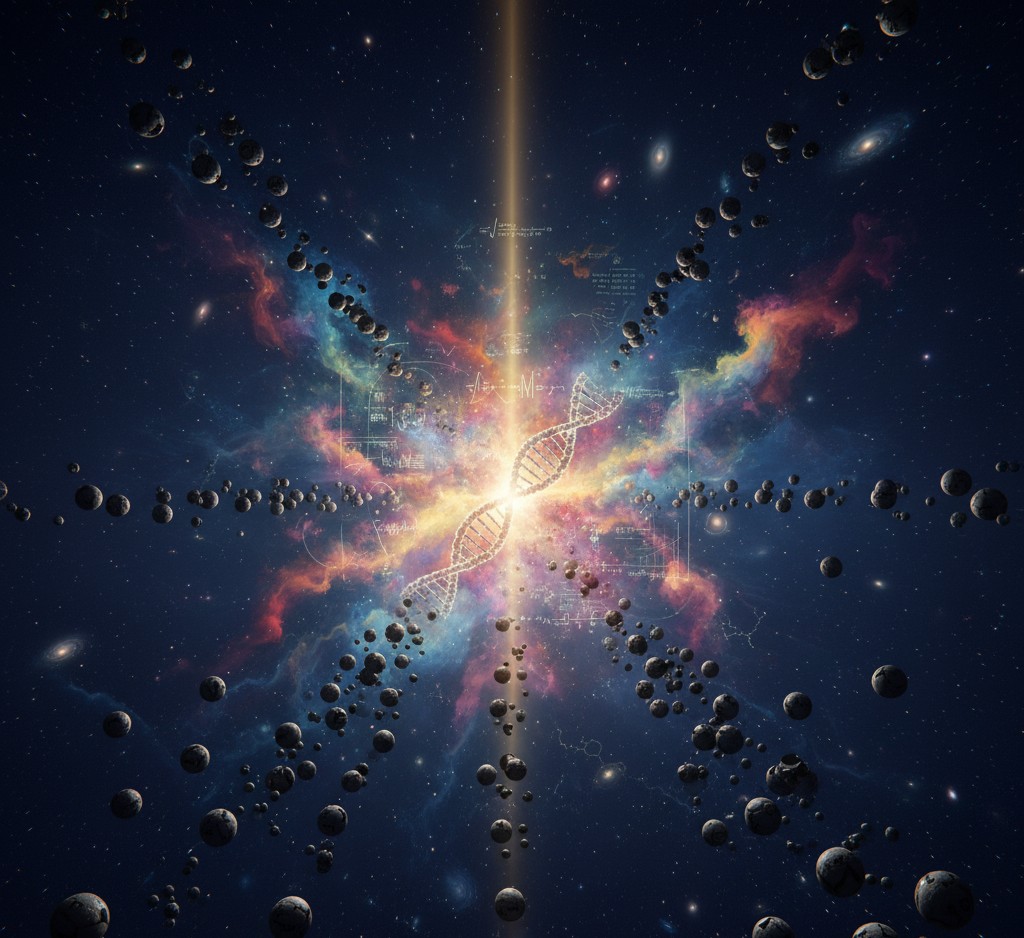
At the heart of Endres’s research lies the concept of organized biological information. Life, in its simplest forms, is not merely a random collection of molecules; it’s an intricately structured system capable of storing, processing, and transmitting information. Consider a single cell: it possesses a genome, complex proteins, and elaborate cellular machinery, all working in concert. The sheer specificity and functional arrangement of these components represent an enormous amount of encoded information. The study highlights how extraordinarily difficult it would be for such organized biological information to form under plausible prebiotic conditions purely by chance.
To illustrate this immense challenge, Endres draws a compelling analogy. Imagine attempting to write a coherent, scientifically accurate article for a leading science website – like StridingTech.com – simply by tossing random letters onto a page. The probability of even a single meaningful word forming by chance is infinitesimal, let alone an entire paragraph, or a complete, insightful article. As the desired complexity increases, the probability of success quickly drops to near zero. This analogy perfectly encapsulates the core difficulty addressed by the research: the jump from disordered chemical chaos to the highly ordered, information-rich systems characteristic of even the simplest life.
Applying Information Theory to the First Cells
To quantitatively explore this issue, Endres employed sophisticated principles from information theory and algorithmic complexity. These powerful mathematical tools allow researchers to measure the information content and the minimum computational steps required to generate a specific outcome. By applying these concepts, Endres sought to estimate what it would take for the first simple cell, often referred to as a protocell, to assemble itself spontaneously from basic chemical ingredients available on early Earth.
A protocell, while rudimentary compared to modern cells, still requires a basic membrane, encapsulated reactions, and some form of self-replication or catalytic activity. Even this simplified model represents a significant leap in organization from its individual chemical precursors. The application of information theory to this problem revealed a startling conclusion: the odds of such a process happening naturally, driven solely by random chemical reactions and environmental forces, are astonishingly low. It suggests that the formation of the necessary intricate molecular organization required for life poses a far greater hurdle than previously acknowledged.
Beyond Random Chance: Re-evaluating Life’s Blueprint
The findings of this study prompt a critical re-evaluation of the “chance alone” hypothesis for life’s genesis. Natural systems tend inherently towards disorder, a concept known as entropy. Building the intricate molecular architectures and precise functional relationships required for even a simple protocell is a monumental task when working against this universal tendency. This doesn’t necessarily mean that abiogenesis is impossible, nor does it definitively point to any specific alternative. Instead, it strongly suggests that random chemical reactions and general natural processes, as currently understood, may not fully explain how life appeared within the limited timeframe available on early Earth.
The research opens up crucial avenues for future investigation. If pure chance is insufficient, what other mechanisms or conditions might have played a role? Could there have been unknown, highly specific environmental catalysts? Did certain prebiotic conditions preferentially select for self-organizing systems in ways we don’t yet fully comprehend? Perhaps the path to life involved a series of extremely constrained, highly probable steps, each building upon the last, rather than one grand, improbable leap. Understanding the “algorithmic complexity” of life’s origin encourages us to look for more deterministic or self-organizing principles that could have guided the assembly process, rather than relying solely on the vast but often unforgiving lottery of random molecular interactions.
The Enduring Quest for Answers
Robert Endres’s work serves as a powerful reminder of the profound complexity inherent in the question of abiogenesis. By applying rigorous mathematical and informational principles, he has quantified the immense improbability of life’s spontaneous assembly from nonliving matter, pushing us to rethink our assumptions. This study does not conclude that life could not have originated from non-living materials, but rather emphasizes the extraordinary challenge involved in such a transition. It compels the scientific community to delve deeper, not just into the raw chemical ingredients, but into the information theoretic and algorithmic requirements for life’s initial formation. As we continue to unravel the universe’s greatest mysteries, understanding the true odds of our own existence remains one of science’s most compelling and elusive quests.