
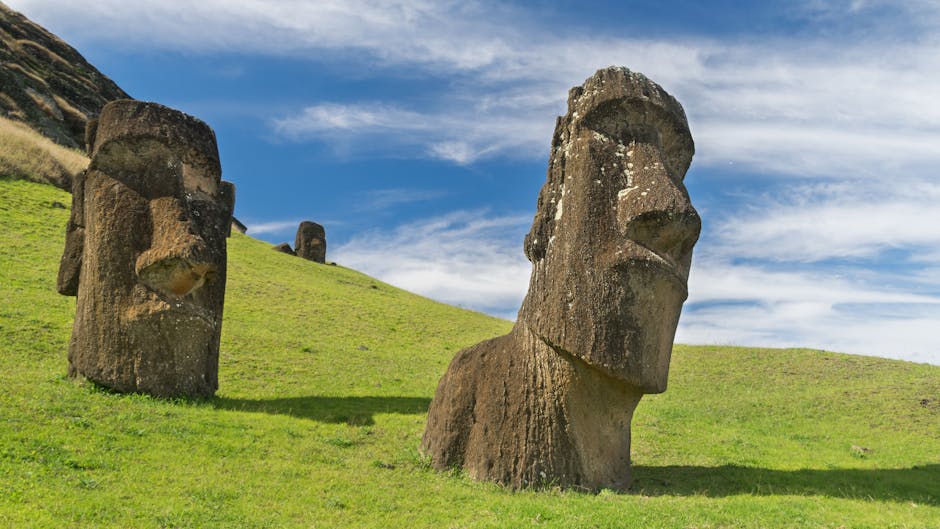
For centuries, the colossal Moai statues of Rapa Nui, better known as Easter Island, have stood as an enduring archaeological enigma. How did an ancient civilization, without modern machinery or beasts of burden, transport these multi-ton monoliths across rugged terrain? The sheer scale of the undertaking, coupled with the island’s isolation, fueled speculation and various theories, many of which cast the Rapa Nui people in a light of resource depletion.
Now, groundbreaking new research, combining physics, advanced 3D modeling, and on-the-ground experiments, definitively solves this stone-cold mystery. The answer isn’t a story of environmental collapse, but one of extraordinary human ingenuity: the statues truly walked, just as local legends have long suggested, challenging long-held assumptions about this remarkable ancient culture.
Solving a Stone-Cold Mystery: The Moai Statues Truly Walked
For centuries, the colossal moai statues of Rapa Nui, better known as Easter Island, presented an enduring archaeological enigma: how did an ancient civilization, lacking modern machinery or even beasts of burden, move these multi-ton monoliths across rugged terrain? New research combining physics, high-resolution 3D modeling, and on-the-ground experiments definitively confirms a long-held local legend: the statues walked.
A team including Carl Lipo, Professor of Anthropology at Binghamton University, State University of New York, and Terry Hunt from the University of Arizona, led the comprehensive investigation. They studied nearly 1,000 moai statues across the island, applying rigorous scientific methods to unravel this architectural puzzle.
The “Walking” Mechanism: Ropes, Rocking, and Roads
The Rapa Nui people, the indigenous inhabitants of this isolated Polynesian island, employed ropes and a unique “walking” technique, moving the giant statues in an upright, zig-zag motion. Researchers previously demonstrated this upright, rocking motion via experimental evidence, challenging the long-standing theory that the statues were moved lying prone on wooden devices. According to Lipo, once a statue starts moving, the process becomes surprisingly efficient. “Once you get it moving, it isn’t hard at all – people are pulling with one arm. It conserves energy, and it moves really quickly,” he explained.
Critical to this method were the statues’ distinctive design features. The researchers’ 3D models revealed that the moai possessed wide, D-shaped bases and a deliberate forward lean, typically between 5 and 15 degrees from vertical. These characteristics were not accidental; they represented sophisticated engineering, specifically tailored to facilitate a rocking, zig-zagging movement.
Further supporting the “walking” hypothesis are the “carefully designed roads” found across Rapa Nui. These ancient pathways, measuring approximately 4.5 meters (about 15 feet) wide with concave cross-sections, were ideal for stabilizing the statues during their forward movement. Lipo noted that these roads were an integral part of the transportation process itself, observing that “every time they’re moving a statue, it looks like they’re making a road. The road is part of moving the statue.”
Challenging Old Theories and Proving Efficiency
This research directly refutes the popular, though problematic, theory of horizontal transport, which suggested the Rapa Nui people used wooden sledges or rollers to move the moai. That method would have demanded vast amounts of timber, contributing to significant deforestation and fueling theories of ecological collapse on the island. The “walking” method, by contrast, required minimal resources and labor, highlighting the ancient islanders’ ingenious problem-solving rather than environmental destruction.
To put their theory to the test, Lipo’s team constructed a 4.35-ton replica moai incorporating the identified forward-lean and D-shaped base design. With just 18 people, they successfully transported the replica 100 meters (about 328 feet) in a mere 40 minutes. This experiment demonstrated a significant improvement over earlier attempts at vertical transport, which often used incorrectly proportioned models. Lipo emphasized the scalability of the method: “The physics makes sense. What we saw experimentally actually works. And as it gets bigger, it still works. All the attributes that we see about moving gigantic ones only get more and more consistent the bigger and bigger they get, because it becomes the only way you could move it.”
The Moai and Rapa Nui: Cultural Context
The moai themselves are monolithic human figures carved by the Rapa Nui people between approximately 1250 and 1500 CE. These statues, almost all carved from the easily worked volcanic tuff of the Rano Raraku quarry, represent deified ancestors, serving as symbols of authority and power, and were believed to be repositories of sacred spiritual essence, or mana. The vast majority of the nearly 1,000 moai on Rapa Nui face inland, watching over the villages, with their backs to the sea. While many are still located in the Rano Raraku quarry, hundreds were successfully transported to stone platforms called ahu around the island’s perimeter. The largest moai ever erected, named Paro, stood nearly 10 meters (33 feet) tall and weighed 82 tons, though another shorter moai at Ahu Tongariki was heavier at 86 tons.
Further archaeological evidence supports the “walking” method by analyzing the distribution of abandoned statues. Over half of the unfinished or broken moai were concentrated within two kilometers of the Rano Raraku quarry, displaying an exponential decay pattern. This pattern is consistent with mechanical transport failure, suggesting statues occasionally toppled during the intricate walking process, rather than being simply discarded.
Notably, the scientific findings align with Rapa Nui’s own oral traditions, which recount that the statues possessed mystical power and “walked” from the quarry to their ceremonial platforms.
A Testament to Ingenuity
This groundbreaking research not only solves a centuries-old mystery but also reframes our understanding of the Rapa Nui people. It highlights their incredible intelligence, sophisticated engineering capabilities, and deep understanding of physics, achieved with limited resources.
This comprehensive research paints a vivid picture of ancient Rapa Nui’s engineering prowess, confirming that the Moai were meticulously designed with D-shaped bases and a forward lean to facilitate an upright, rocking “walking” motion using ropes. Far from requiring vast timber resources, this ingenious method utilized specially constructed roads and minimal labor, showcasing the islanders’ sophisticated problem-solving skills and resourcefulness. The debunking of environmentally destructive theories in favor of elegant engineering not only clarifies a millennia-old mystery but also reshapes our understanding of the Rapa Nui people as masterful innovators rather than ecological culprits.